Between July and September 2025 the partners ran a baseline knowledge survey with young people in Germany, Italy and Portugal. The results, published in October 2025, guide the design of the board game and the guide for youth workers.
How the survey worked
The survey was a short quiz of 11 multiple-choice questions in two parts: personal finance basics (compounding, net vs. gross income, digital payment risks, inflation, credit scores, consumer rights) and civic money awareness (budget deficit, informal work and taxes, GDP, inclusive growth). Respondents came from Italy (38), Portugal (36), Germany (31) and other countries (5); more than half were students and 16% unemployed and looking for work.
The three biggest gaps
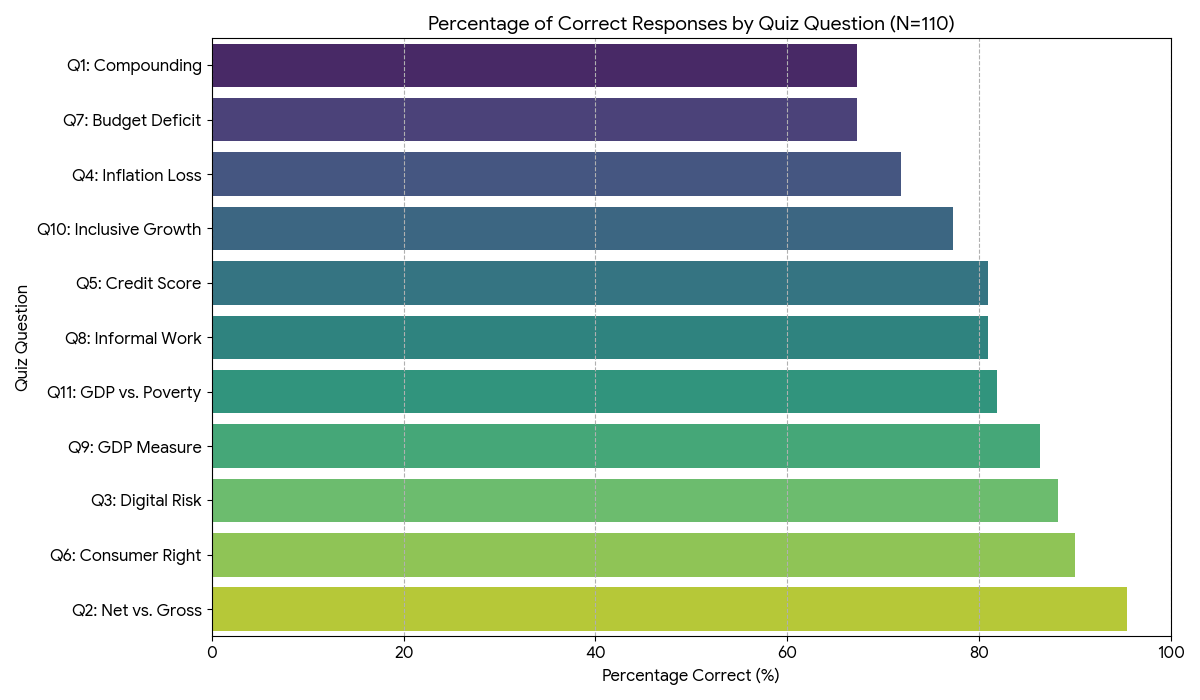
- Compounding – 67.3% correct: the advantage of saving and investing early is not intuitive.
- Budget deficit – 67.3% correct: government-finance terms are unclear to many young people.
- Inflation loss – 71.8% correct: calculating the real loss of purchasing power is difficult.
Scores were lowest in Portugal (7.92 of 11), followed by Italy (8.87) and Germany (9.80). Young people who are unemployed (8.50) or work part-time (8.54) scored lowest among the main groups.